
Prospects aren't just Googling "apartments near me" anymore. They're asking ChatGPT which community has the best management. They're reading Google's AI Overview summary of your property before they ever see your website. And in both cases, the answer they get is shaped largely by one source you don't write yourself: your reviews.
For years, multifamily marketers treated reviews as a reputation issue - something the on-site team managed and marketing monitored. In 2026, that framing is outdated. Reviews and ratings are now ranking inputs. They influence where your community appears in traditional search, whether it appears at all in AI-generated recommendations, and how AI describes your property to a prospect.
Understanding how these systems use reviews can help communities know where to focus.
Two Different Systems, Two Different Rules
Your average star rating plays a fundamentally different role in traditional search than it does in AI recommendations.
In traditional local search, your rating is a weighted factor. Whitespark's 2026 Local Search Ranking Factors study - the industry's most cited annual research - puts review signals at roughly 20% of local pack ranking influence, up from 16% in 2023. That makes reviews one of the top three factor categories, alongside Google Business Profile signals and on-page SEO. Google confirms this in its own documentation: more reviews and more positive ratings can improve your local ranking. A community with a 3.9 rating can still rank; it just competes at a disadvantage against the 4.6 down the street.
In AI recommendations, your rating behaves more like a threshold. When a prospect asks an AI assistant for apartment recommendations, the system typically returns three to five options - not a page of links. Multiple industry analyses of AI-generated local recommendations have found a similar pattern: businesses below a certain reputation floor aren't ranked lower, they're excluded from consideration entirely. A Trustpilot analysis of 800,000 AI-generated answers found that businesses with little or no review presence rarely appeared in AI recommendations at all. AI systems treat reputation as a confidence filter - if your review signals don't clear the bar, other strengths may never come into consideration.
Consumer behavior is showing a similar shift. BrightLocal's 2026 Local Consumer Review Survey found that 31% of consumers will now only consider businesses rated 4.5 stars or higher - nearly double the 17% from the year before - and 74% want to see reviews from the last few months. Meanwhile, 45% of consumers report using AI tools for local business recommendations, up sharply year over year.
A mediocre rating used to cost you your position. Now it can cost you visibility in the channels where a growing share of renters start their search.
AI Doesn't Count Your Stars, It Reads Your Reviews
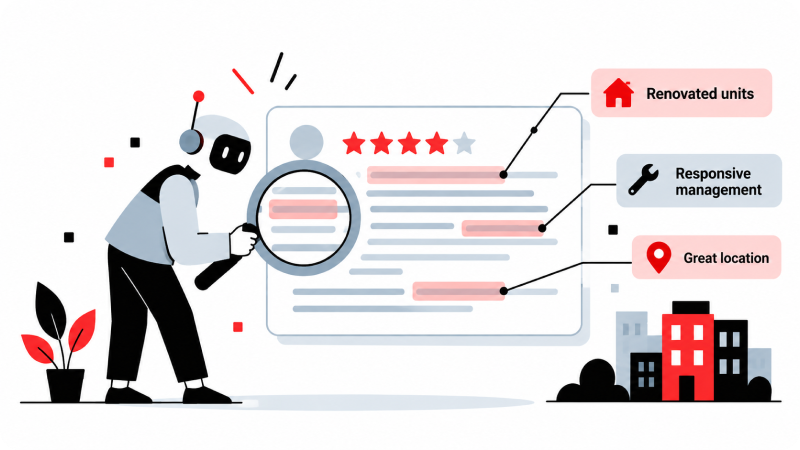
AI systems don't just look at your rating. They read the actual text of your reviews and use it to understand and summarize your community.
Google's AI Overviews increasingly pull themes directly from review content into the short blurbs prospects see first. If "maintenance delays" or "hidden fees" appear repeatedly across your reviews, AI may summarize your community around those same themes before a prospect ever clicks through to your website. The reverse is also true: reviews that mention your renovated units, responsive office team, or specific neighborhood become valuable context behind a positive AI-written description.
This is why review content now matters as much as review count for a few key reasons:
Specificity strengthens relevance. Reviews that mention floor plans, amenities, the neighborhood, or the leasing experience give search engines and language models concrete signals to associate with your community. A detailed review mentioning "the one-bedroom renovation" and your submarket does more for visibility than five reviews that just say "great place."
Recency signals that you're active. Language models and local algorithms both treat fresh reviews as a signal that a business is active and trustworthy. A community whose last review is eight months old starts to look dormant - regardless of how strong the older reviews are. Whitespark's survey respondents rank review recency among the most influential individual review factors, and a steady cadence of new reviews consistently outperforms occasional bursts.
Responses count as engagement. Owner responses are read as a trust signal by both traditional ranking systems and AI platforms. Communities that respond to most of their reviews - including the negative ones, handled professionally - send a signal that the property is managed and responsive. An ignored one-star review can hurt in two ways: it lowers the average and leaves the concern unaddressed.
A perfect 5.0 isn't necessarily the goal. A flawless average built on thin, generic reviews can read as inflated or manipulated. A 4.5-4.8 average built on detailed, recent, authentic reviews - with a few negatives that received thoughtful responses - can create a stronger profile in both traditional and AI-driven search.
GBP Signals vs. Review Signals: Know the Difference
Your Google Business Profile is one of the most important listings for both traditional local rankings and AI visibility - but it contains two distinct signal categories that require different management approaches.
GBP signals (~32% of local pack ranking influence) are the attributes of the profile itself - the things you directly control in the dashboard:
- Primary business category (one of the most influential factors - "Apartment complex" vs. "Apartment rental agency" matters)
- Secondary categories, service areas, and attributes
- Accurate hours - being open at the time of search is now a top-five individual ranking factor
- Profile completeness: description, photos, amenities, contact info
- Verification status and address consistency
Think of this as how well your profile is structured. It's largely a one-time optimization plus quarterly maintenance. Once the foundation is in place, ongoing maintenance is relatively straightforward.
Review signals (~20% of local pack ranking influence) are the reputation layer generated by your residents and prospects - data about you rather than from you:
- Average star rating
- Review volume relative to competing communities
- Review recency and velocity
- Keywords and themes within review text
- Owner response rate and quality
- Review presence across platforms beyond Google
Think of this as how much third-party evidence exists that your community is trusted and active. Unlike GBP signals, this category is never "done." Recency matters over time. It requires an ongoing system: consistent review generation, timely responses, and monitoring.
The distinction matters because most communities treat their GBP as a set-it-and-forget-it listing and their reviews as something to address when something goes wrong. The communities building stronger visibility in 2026 have flipped that: profile hygiene is routine, and review generation is an always-on operational process.
What Your Community Website Still Needs to Do
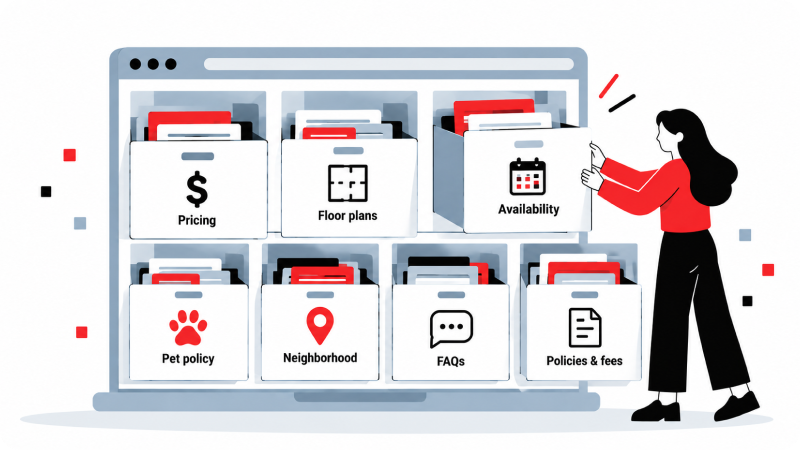
Reviews and GBP help you get discovered. Your website is what search engines and AI systems use to verify and describe you. For traditional rankings and AI visibility, on-site priorities for an apartment community include:
Make critical details machine-readable. Pricing, floor plans, availability, pet policies, and fees should live as actual text on the page - not trapped inside images, PDFs, or JavaScript-heavy widgets that AI crawlers may fail to render. If an AI agent can't read your pricing, it can't recommend you to a prospect asking about budget.
Implement structured data. Schema markup (ApartmentComplex, LocalBusiness, FAQPage) gives both Google and language models a clean, structured version of your key facts. Content marked up with FAQ schema appears more frequently in AI-generated answers because it's already formatted in a way these systems can easily understand.
Answer real prospect questions in plain language. AI systems favor pages that directly answer conversational queries - "Is [community] pet friendly?", "What's included in the amenity fee?", "How far is [community] from downtown?" A well-built FAQ or neighborhood page that answers these plainly becomes useful source material for AI responses.
Keep your local pages substantive. Neighborhood context, nearby employers, walkability, and transit details help both traditional local relevance and AI's ability to match your community to a prospect's stated needs.
Ensure consistency everywhere. AI systems cross-reference your website against your GBP, ILS listings, and review platforms. Mismatched hours, names, addresses, or pricing across sources can weaken the confidence signals AI relies on. Consistency isn't cosmetic - it's part of how these systems verify information.
Allow the crawlers. AI platforms can only cite what they can access. Review your robots.txt and firewall settings to confirm you're not inadvertently blocking the LLM crawlers you want recommending your community.
The Bottom Line
Search visibility used to be a contest of keywords and backlinks. Increasingly, it's about the full picture of your online presence - and your residents are writing most of it. Your GBP structure helps establish your presence, your rating can influence whether AI considers you, and your review content shapes the actual words a prospect reads about your community in an AI-generated answer.
The communities that treat reputation as an always-on marketing system - not a quarterly cleanup project - are the ones best positioned to stay visible as renters shift from search results pages to AI-generated recommendations.