Request Demo
Sign-up for a demo to see how our solutions can help you improve website conversion rate, generate more leases and simplify reporting.

 Back
Back Copy link
 Share on LinkedIn
 Share on X
 Share on Facebook

The start of a new year is one of the most valuable moments on the multifamily marketing calendar. Budgets reset, goals are newly defined, and teams have a rare opportunity to pause before the pace of peak leasing season accelerates. For marketers, January isn’t just about launching new campaigns - it’s about making sure the foundation beneath those campaigns is strong enough to support growth all year long.
As Q1 kicks off with a focus on Digital Marketing Foundations, now is the time to take a data-driven look at your current campaigns. A thoughtful audit and optimization process can reveal what’s working, uncover inefficiencies, and ensure your marketing strategy is aligned with leasing and business objectives for 2026.
Why January Is the Right Time to Audit Your Marketing
Marketing audits are often associated with fixing problems, but in reality, they are about clarity. January offers cleaner data, fewer competing initiatives, and the flexibility to make meaningful changes before demand ramps up. It’s the ideal moment to step back and ask whether your marketing systems, tools, and tactics are truly working together.
A comprehensive audit allows multifamily marketers to move beyond assumptions. Instead of relying on last year’s habits or surface-level performance indicators, teams can identify what actually influenced leasing outcomes, where spend was inefficient, and how campaign performance can improve with better alignment and structure.
Reground Your Strategy in Clear Objectives and KPIs
Before evaluating channels, creative, or budgets, it’s critical to revisit the purpose behind each campaign. Every marketing initiative should be tied to a clearly defined goal, whether that goal was driving occupancy, reducing vacancy time, supporting a lease-up, or improving cost efficiency.
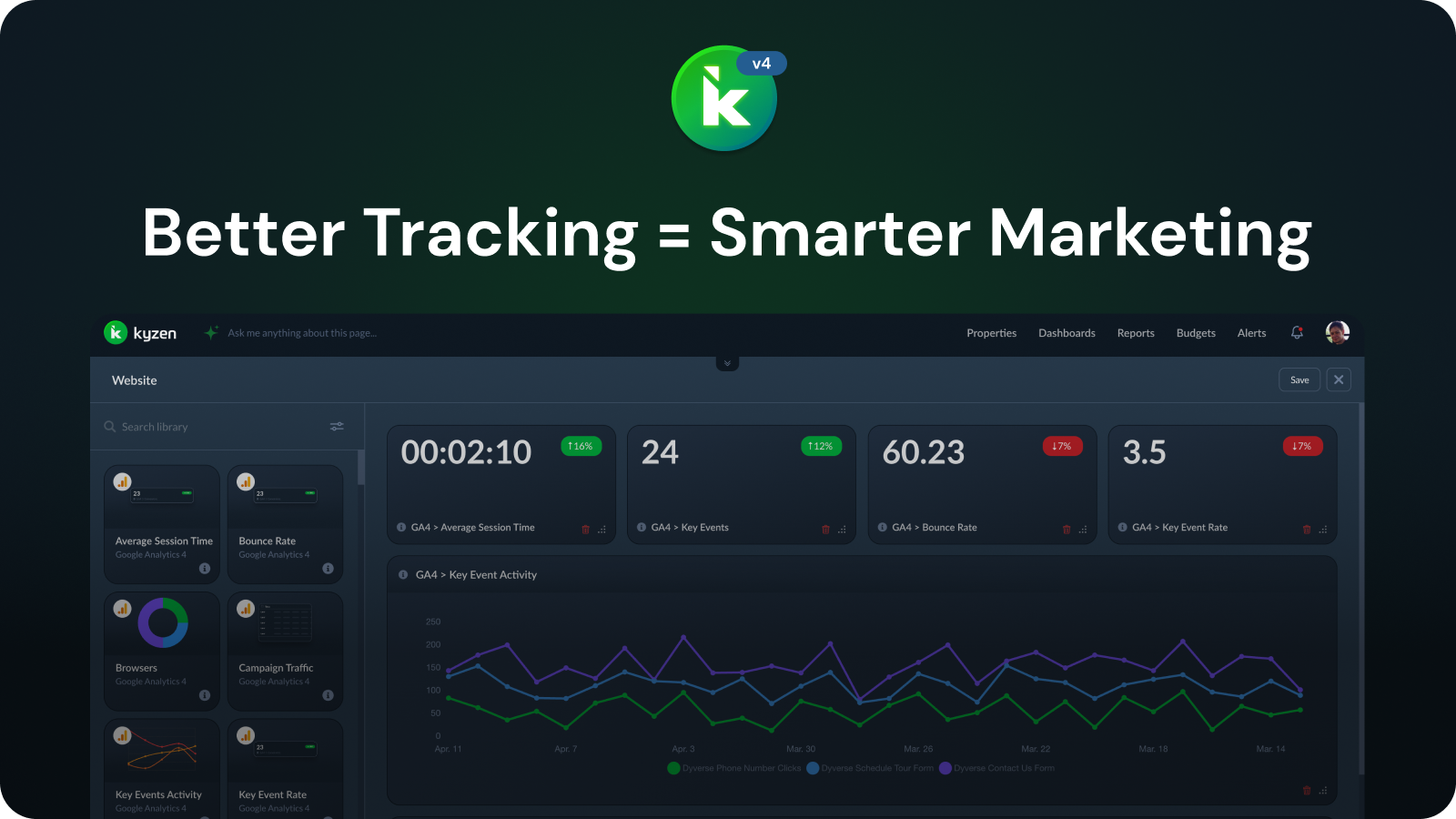
Too often, performance is judged by metrics that don’t fully reflect success. Clicks, impressions, and raw lead volume may indicate activity, but they don’t always tell the full story. A stronger audit focuses on metrics that directly connect marketing efforts to leasing outcomes, such as cost per lease, conversion rates throughout the funnel, source-level lease attribution, and days vacant.
At Dyverse, we emphasize attribution clarity through various tools, like our own Kyzen Analytics. Understanding which channels truly contribute to signed leases allows marketers to make informed decisions about where to invest, scale, or pull back - and removes the guesswork from performance analysis.
Evaluate the Strength of Your Data and Attribution
Once objectives and KPIs are clearly defined, the next step is ensuring your data can actually support them. Many multifamily marketers struggle with fragmented reporting systems, inconsistent lead source naming, or incomplete attribution across platforms. Without reliable data, even the best strategy can falter.
A January audit should examine whether tracking is consistent across paid media, ILS platforms, websites, and CRM systems. It should also assess whether attribution models accurately reflect the renter journey or if multiple channels are competing for credit without a clear picture of influence.
Strong data foundations make optimization possible. When cost-per-lease auditing and attribution automation are in place, marketing teams can shift from reactive reporting to proactive decision-making - adjusting campaigns based on insight rather than instinct.
Look Beyond Volume When Reviewing Channel Performance

Channel analysis is most effective when it focuses on quality and efficiency, not just scale. High lead volume can be misleading if those leads fail to convert or require excessive spend to close.
A more meaningful review examines how each channel contributes to the leasing funnel. Which sources consistently deliver high-intent prospects? Which channels perform better at specific times of year? Are there platforms absorbing budget without producing proportional leasing results?
By reframing channel performance through the lens of lease contribution and cost efficiency, marketers can uncover opportunities to reallocate spend in ways that immediately improve ROI, without increasing overall budgets.
Assess Creative, Messaging, and Targeting Alignment
Even the most well-funded campaigns can underperform if creative and messaging are misaligned with renter expectations. Over time, creative fatigue, outdated value propositions, or overly broad targeting can quietly erode results.
January is an ideal time to evaluate whether messaging still reflects what today’s renters care about most. Value, flexibility, lifestyle amenities, sustainability features, and community experience all play a role in modern leasing decisions. Creative should feel fresh, relevant, and tailored to the local market rather than generic or recycled.
Targeting strategies also deserve attention. Campaigns that focus on high-intent audiences, leverage retargeting effectively, and personalize messaging by floor plan or lifestyle tend to perform more efficiently than broad, one-size-fits-all approaches.
Identify Where Prospects Drop Off in the Funnel
An effective marketing audit doesn’t stop at lead generation. Many performance issues arise later in the renter journey, where prospects disengage due to slow response times, inconsistent follow-up, or disjointed transitions between digital and in-person experiences.
Understanding where prospects stall or drop off allows teams to optimize processes beyond advertising. Improvements to automation, tour scheduling, follow-up cadence, and messaging continuity often lead to meaningful conversion gains without additional acquisition spend.
Marketing success is rarely about doing more - it’s about removing friction.
Optimize Budgets Based on What the Data Reveals
With insights from your audit in hand, January becomes the perfect moment to rebalance budgets. Channels that consistently deliver leases at an efficient cost can be scaled, while underperforming sources can be reduced or refined.
Data-backed optimization enables marketers to test new ideas responsibly, plan for seasonality, and ensure that spend is aligned with both short-term leasing needs and long-term growth goals. When attribution is clear, budget decisions become strategic rather than reactive.
Build a Repeatable Optimization Framework
The most successful marketing teams treat audits as part of an ongoing system, not a one-time exercise. Establishing regular review cycles, clear benchmarks, and shared performance dashboards creates a culture of continuous improvement.
At Dyverse, we work with multifamily marketers to build marketing systems that evolve throughout the year - using data, attribution, and performance insights to drive smarter decisions month after month.
Final Thoughts: Strong Foundations Create Smarter Growth
January sets the tone for everything that follows. By auditing campaigns early, strengthening data foundations, and optimizing with intention, multifamily marketers position themselves for a more efficient, adaptable, and successful year.
In 2026, marketing advantage won’t come from bigger budgets or more tactics - it will come from better systems, clearer insights, and smarter execution.
If you’re ready to take a deeper look at your campaigns and data strategy, Dyverse is here to help you build a foundation designed for long-term performance.

More from Dyverse

Reflecting on 2025: Key Takeaways for Multifamily Marketing - and What’s Next for 2026
As 2025 draws to a close, multifamily operators and marketers alike are in that classic “pause and assess” moment...

Building Trust Through Social Proof, Reviews, and Resident Stories
In multifamily marketing, gaining attention is only the first step. Trust is what turns interest into action. Prospects today have more options, more information, and higher...

Measuring Marketing ROI with Data: How to Track and Optimize Your Multifamily Marketing Strategy
In today’s competitive multifamily housing market, marketing efforts need to be both effective and efficient. But how can you tell if your campaigns...
Want more?
Subscribe to get the latest updates on multifamily marketing, technology, and more.

Keep up with us!
For the latest updates be sure to connect with us on our social platforms.


Let's start a conversation
Schedule a demo to discuss how Dyverse can help you boost your leasing performance.


Suite 1000
Orlando, FL 32801
(866) 832-1507


